February is almost over. Most Forest Hills homeowners are mentally done with winter.
That is the most dangerous place to be right now.
March in Queens is not spring. It is the month that catches you completely off guard — a week of 50-degree days followed by a Thursday night that drops to 19 degrees. Your furnace that barely made it through February now has to handle one more serious cold stretch.
And if it has been struggling all winter, March is when it finally gives out.
At Day Night HVAC & Plumbing Inc. we get more furnace breakdown calls in early March than almost any other time of year. Not because March is the coldest month — but because homeowners stopped paying attention to their furnace the moment they smelled spring in the air.
Do not let that be you.
Think about what your furnace has been through since October.
Five months of daily operation. Cycling on and off dozens of times every single day. Heating your entire Forest Hills home through every cold Queens night since fall.
By the time March arrives, worn components are right at the edge of failure. Dirty flame sensors are barely doing their job. Heat exchangers that developed small cracks back in December are worse now. Blower motors that started vibrating in January are one cold night away from stopping completely.
The furnace that got you through winter is not in the same condition it was when heating season started.
Here is what happens every single year.
Homeowners notice their furnace acting strange in late February — taking longer to heat the house, making a new noise, cycling on and off oddly. They think it is almost spring anyway and decide to deal with it next fall.
Then March 8th arrives with four days of temperatures in the low 20s.
The furnace that was limping through February cannot handle it. It shuts down completely at 10pm on a Tuesday.
Now it is an emergency repair instead of a scheduled tune-up. Emergency calls cost more, take longer, and happen at the worst possible moment.
If your furnace is showing any of the signs below, call right now — not in April.
Your furnace used to have the house at 70 degrees within 20 minutes. Now it runs for 45 minutes and barely gets there.
This is not the weather getting colder. This is your furnace losing efficiency — usually from dirty burners, a failing blower motor, or a heat exchanger that can no longer transfer heat properly.
This is called short cycling and it is one of the clearest signs something is wrong.
The most common causes are a dirty flame sensor that cannot detect the burner flame accurately, a clogged filter causing the system to overheat, or a high-limit switch tripping as a safety response. None of these fix themselves.
That bang is delayed ignition — gas building up in the burner before it finally ignites instead of lighting immediately.
It is one of the most serious furnace warning signs there is. Every time it happens it puts stress on your heat exchanger. A cracked heat exchanger means carbon monoxide entering the air your family breathes — silently, without any smell.
A furnace losing efficiency burns more gas to produce the same amount of heat.
If your bill climbed noticeably compared to the same months last year with no change in how you use heat, your furnace is working harder than it should be. That extra cost on your bill is the system warning you something is wrong.
Uneven heating throughout your Forest Hills home means the furnace is no longer moving enough heated air through the duct system to reach every room evenly.
This is almost always a blower motor issue, a ductwork problem, or a system that is no longer producing enough heat output to cover your entire home under load.
A brief dusty smell at the very beginning of heating season is normal. A burning or metallic smell appearing now — in late February or March — is not.
It means something inside the system is overheating. This needs a technician the same day, not an open window.
Most homeowners think furnace maintenance is just a filter change. It is not.
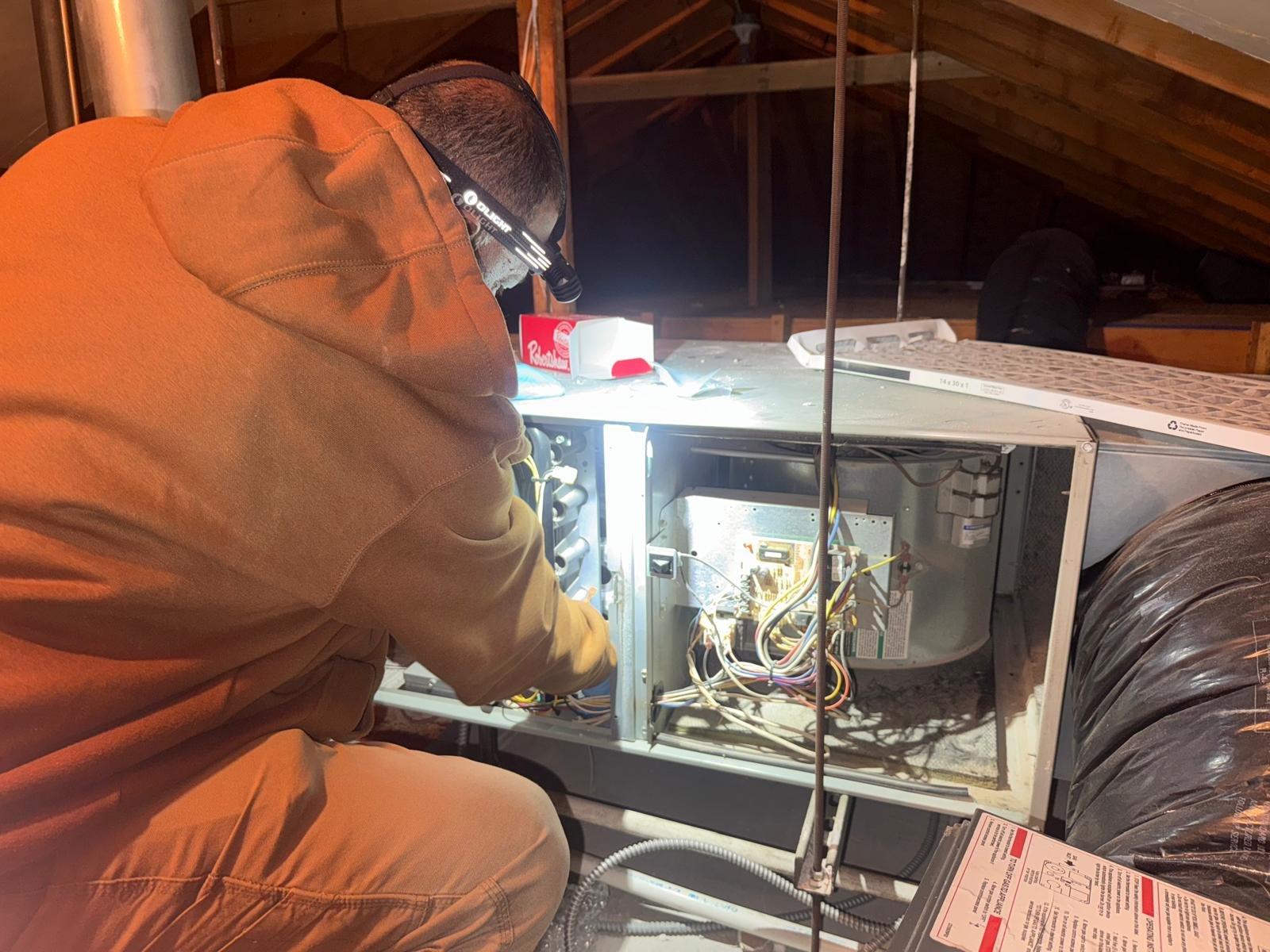
A proper tune-up from a licensed Day Night HVAC & Plumbing Inc. technician covers everything that affects your safety and performance heading into March:
Burner cleaning — carbon buildup causes incomplete combustion and reduces the heat your system actually delivers into your home.
Heat exchanger inspection — the single most important safety check in any furnace tune-up. A cracked heat exchanger allows carbon monoxide into your living space with zero warning. CO has no smell, no color, and no taste.
Flame sensor cleaning — a dirty sensor cannot accurately read the burner flame and causes the furnace to shut off prematurely after every startup cycle.
Igniter inspection — igniters degrade over time and are one of the most common reasons a furnace suddenly will not start on a cold morning.
Blower motor check — the blower pushes heated air through every duct in your home. A struggling blower reduces airflow to every room simultaneously.
Flue and venting inspection — a blocked flue traps combustion gases inside the system. Completely preventable and completely dangerous if missed.
Thermostat calibration — so what you set is actually what your home reaches on a cold March night.
The whole process takes about 75 to 90 minutes. Getting it done now means any developing problems are caught and fixed before the next cold stretch arrives.
A furnace under 12 years old facing a repair under $500 — fix it without hesitation.
A furnace over 18 years old facing a heat exchanger replacement or major blower motor failure — replacement is almost always the smarter financial decision. Modern high-efficiency furnaces operate at 96% efficiency compared to the 60 to 70% typical of systems installed in Forest Hills homes in the 1990s. The savings on your National Grid bill alone often cover the cost of a new system within six to seven years.
Somewhere in between those two situations? We give you an honest written assessment before any work begins. No pressure, no upselling — just the real numbers so you can make the right call for your home and your budget.
If your Forest Hills home does not have a working CO detector near the furnace and on every sleeping floor, stop reading and install one today.
Carbon monoxide from a cracked heat exchanger has no smell, no color, and no taste. The only detection method is a properly functioning CO detector.
Any furnace that has not been professionally inspected in the last 12 months, is over 15 years old, or has been short-cycling, banging on startup, or producing inconsistent heat should be treated as a potential CO risk until a licensed technician inspects the heat exchanger directly.
We are a Queens-based licensed HVAC company serving Forest Hills, Rego Park, Kew Gardens, Middle Village, Jamaica Estates, and all surrounding neighborhoods.
Same-day service. 24/7 emergency response. Flat-rate written quotes before any work starts. No Long Island dispatch times, no 866 numbers routing to a call center two boroughs away.
March is almost here. Call Day Night HVAC & Plumbing Inc. now to schedule your furnace repair or furnace maintenance in Forest Hills, NY — before the last cold snap of the season finds your system unprepared.